
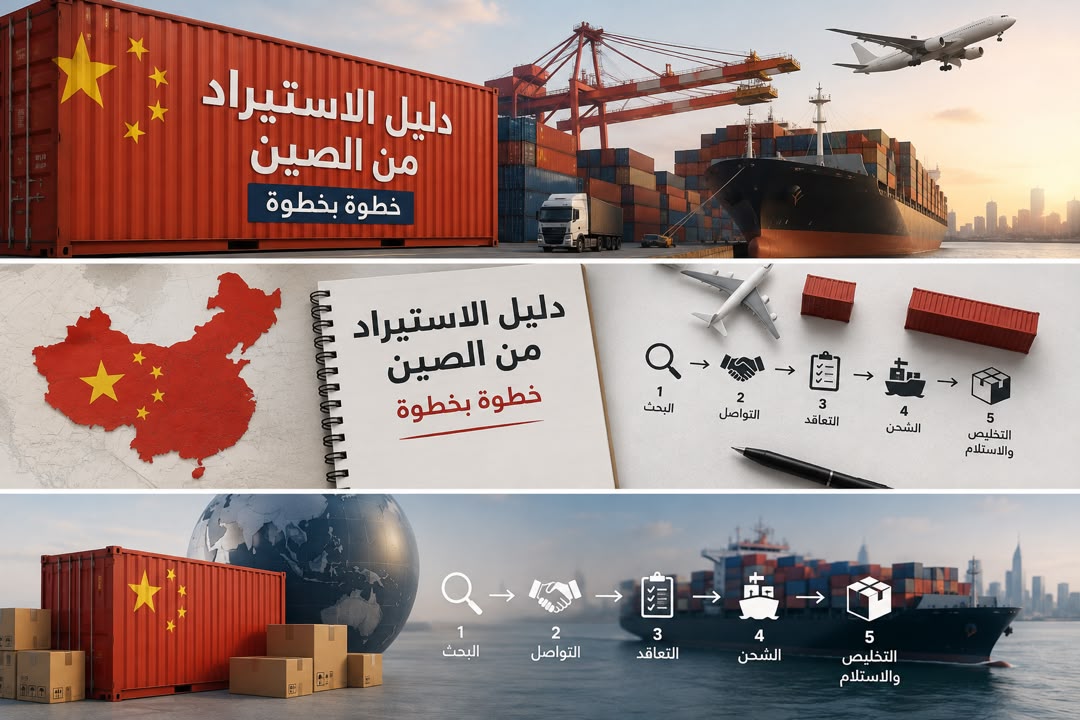
Importing from China means buying goods from a Chinese manufacturer or supplier, arranging shipping and customs clearance, and receiving them at your warehouse. In practice, it involves ten steps. Success depends on a verified supplier, written specifications and a fully calculated landed cost before payment.
This guide covers the steps, conditions, costs and common mistakes for importers, traders, factories and businesses in Egypt and the Arab world.
According to NAFEIZ, its sourcing experience spans nine years and more than 3,600 handled shipments.
Important: Customs laws and registration requirements vary by country and change over time. Egypt is used as an example; consult your local customs authority before any transaction.
Requirements for importing from China
Local law determines importer eligibility, while the supplier contract governs export and delivery arrangements.
AreaWhat to verifyImporterLegal authorization to import for resale (commercial registration or importer registry where required) and an accepted international payment methodProductHS Code, customs duties and taxes, restrictions, licenses and conformity certificatesShipmentCommercial invoice, packing list, bill of lading or airway bill, origin or quality certificates when required, and agreed IncotermTen steps to import from China
1. Choose the product and calculate feasibility
Estimate your local selling price and margin after all costs. Check dimensions, weight and fragility, and avoid using registered trademarks without permission.
2. Confirm the product can be imported
Identify the HS Code and ask customs or a licensed broker about duties, restrictions and required certificates before paying. Discovering restrictions after shipment can mean penalties or detained goods.
3. Find suppliers
Search B2B platforms such as Alibaba and Made-in-China, the Canton Fair, wholesale markets such as Yiwu, or a sourcing company. Obtain at least three quotations for comparison.
4. Verify the supplier
Do not rely solely on platform ratings or a supplier profile.
- Request the business license and 18-character Unified Social Credit Code (USCC); check it in China's National Enterprise Credit Information Publicity System (GSXT).
- Distinguish a manufacturer from a trading company with a live factory tour, production-line photographs and clear responsibility for technical issues and compensation.
- Match the bank account holder to the company name; independently confirm any account changes using a previously verified contact channel.
- For larger orders, commission an independent factory audit. Legal registration proves identity, not manufacturing capacity.
This is a frequent stumbling block for new importers. NAFEIZ says it identifies suitable Chinese manufacturers and negotiates prices and terms; consult its services or contact the team.
5. Define specifications and request quotes
Specify materials, dimensions, weight, colors, packaging, quantity and delivery location so suppliers quote the same item. “Plastic box” is not enough: state resin, capacity and wall thickness. Ask whether the minimum order quantity (MOQ) applies to the whole order or each color or size. Lower prices may reflect different materials or packaging.
6. Approve a sample
Order and inspect a sample, attach the approved specifications to the contract and retain a reference sample. Sample quality alone does not guarantee bulk-production quality.
7. Negotiate and sign the contract
Document specifications, acceptance criteria, quantities, prices, Incoterm, payment schedule, delay penalties and dispute resolution in a signed contract or purchase order (PO) and pro forma invoice. Payment options include bank transfer (T/T), letter of credit (L/C) and documentary collection. Deposits are negotiated; no universal percentage applies. Avoid personal bank accounts and large payments without a signed agreement.
8. Monitor production and inspect before shipment
Request production photos and videos and conduct a pre-shipment inspection using an agreed acceptable quality limit (AQL). Link final payment to the inspection result. Visual inspection does not replace regulatory conformity testing. NAFEIZ describes pre-shipment checks of quality, quantity and packaging, alongside production monitoring.
9. Choose shipping and delivery terms
Sea freight, whether full-container load (FCL) or less-than-container load (LCL), is usually cheaper for larger volumes but slower. Air freight is faster and costlier for urgent or light goods; express shipping suits samples and small parcels. Choose the Incoterm with care.
10. Clear customs and receive the goods
Submit documents, pay duties and taxes, and allow for customs inspection. A licensed customs broker is recommended. Check quantities and condition promptly on delivery and photograph damage within the contractual claim period.
Incoterms: who is responsible for what?
ICC Incoterms 2020 allocate transport, insurance, clearance responsibilities and the point of risk transfer between buyer and seller; they do not regulate payment. Specify the term, named place and edition, for example “FOB Shanghai Port, Incoterms 2020”.
TermMeaningWatch out forEXWGoods placed at buyer's disposal at seller's premisesBuyer bears extensive responsibilities within ChinaFCADelivery to the buyer's nominated carrier at an agreed locationOften better suited to container shipments according to ICC Academy guidanceFOBGoods delivered on board the vessel at the loading portSea transport only; often unsuitable for containers delivered first to a terminalCIFSeller pays freight and insurance to destination portRisk transfers on loading; only minimum insurance is requiredDAP / DDPDelivery at destination; DDP includes import clearance and duties by sellerBuyer clears under DAP; verify seller's ability to perform DDPFor more information, consult ICC Academy's “Know Your Incoterms” and its FCA versus FOB guidance.
How to calculate landed cost
The factory price is not your final cost. Landed cost includes merchandise, transport and export handling in China, international freight, insurance, duties and taxes, port and storage charges, customs-broker fees and delivery to the warehouse. Divide by saleable units.
Illustrative example only: $12,000 total ÷ 2,000 units = $6 landed cost per unit. Never apply one customs-duty rate to all imports; obtain a product-, HS Code- and origin-specific estimate.
Importing from China to Egypt: key considerations
Separate importer eligibility, product rules and shipment procedures, and verify current requirements with official bodies.
- Importers registry: Commercial imports require registration with GOEIC under Law 121/1982 as amended. Changes and implementing regulations were introduced in 2026; do not rely on older guidance.
- Factory registration: Decree 43/2016 requires foreign manufacturers of certain goods to register, with conditions amended by Decree 195/2022. This does not apply to every Chinese factory or every product.
- ACI and ACID: Submit advance cargo information through Nafeza before shipment to obtain an ACID number. Published sea-freight guidance mentions at least 48 hours before vessel departure; mandatory ACI for air cargo was announced from January 1, 2026. Verify current rules for your shipment. ACI does not replace importer eligibility or product compliance.
- Common documents: Commercial invoice, packing list, bill of lading copy, certificate of origin and any product-specific certificates. Check names, quantities and values for consistency.
Common import mistakes
- Choosing the cheapest quote without comparing materials, packaging and delivery terms
- Paying a deposit before verifying import eligibility and the supplier
- Relying on a sample without written specifications and a contract
- Skipping pre-shipment inspection before settling the balance
- Assuming CIF leaves all transit risk with the seller
- Ignoring port and clearance costs or postponing ACID and paperwork until dispatch
Frequently asked questions
Can I import without an importers registration?
It depends on the country and purpose. Egypt requires registration for commercial imports, while personal use and small shipments can follow different rules. Confirm current requirements with customs.
What is MOQ?
Minimum order quantity: the smallest amount a supplier will sell under stated conditions. It may be negotiable for stocked goods.
How do I distinguish a factory from a trader?
Request a license, live factory video and production photos; check whether registered business activities include manufacturing and establish factory ownership.
Which Incoterm is best for a new importer?
No term suits everyone. FCA is often more appropriate than FOB for containerized cargo, while EXW leaves more work to the buyer. Match the term to the actual handover and your shipping capabilities.
Does Egypt's ACI system cover air freight?
Yes. Mandatory application for air cargo was announced for January 1, 2026. Confirm the procedure for your shipment before booking.
How long does importing take?
There is no fixed timeline. Verification, samples, production, shipping and customs depend on product, season and transport mode. Request a written schedule with contingency time.
How does NAFEIZ work?
Visit the NAFEIZ services and About Us pages to learn which sourcing stages the company handles.
Start with a clear import plan
Before requesting your next quote, prepare product specifications, target quantity, delivery destination and required date. Contact NAFEIZ to discuss an appropriate sourcing and shipping plan, or explore its services first.